Gravitation and Cosmology
(Claes Uggla, Marcus Berg)
Of the four known
fundamental forces (the strong and weak nuclear forces, the
electromagnetic force, and the gravitational force) only gravity affects
everything. And gravity affects everything in the same way, though
its strength gradually decreases with distance. As a consequence, even though
gravity is the weakest of all forces, it is gravity that determines how planets
move, how large stars die, how large scale structures like galaxies and clusters
of galaxies form, and how the university as a whole develops.
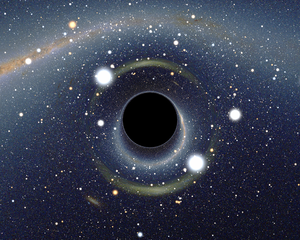
Taking the above properties of gravity as his starting point, and combining this
with his theory of special relativity, Einstein came up with
the idea that gravity could be described by means of
curved spacetime geometry
instead of a force in 1907, an idea Einstein considered to be his best idea
ever. After 8 years of additional struggles, Einstein finally managed to
describe how matter curves spacetime geometry in 1915 when he presented what is
now known as Einstein's field equations and the theory of
general
relativity. This led to the picture that matter tells spacetime how to curve,
and spacetime curvature tells matter how to move.
Already from the outset Einstein used his theory of
general relativity to make
observable predictions that differed from those of Newtonian gravitational
theory. Observations quickly showed Einstein to be right, but it took time for
Einstein's theory to make a large impact. One of the predictions of Einstein's
theory is that time is affected by gravity and that time passes
more slowly in a strong
gravitational field than in a weaker one. As a consequence, your feet age slower
than your head, by slightly less than a billionth of a second every year
(gravity decreases with height), an effect that was confirmed by experiments
around 1960. This might sound abstract, but it is real: scientists
need to be aware of this effect
when guiding satellites that explore the solar system, to minimize their
fuel consumption, which to a large extent determines the cost for such missions.
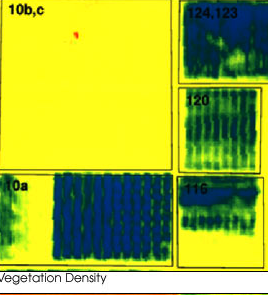
This framework is also relevant for more down-to-earth applications
like
GPS,
which is used everywhere from bus and car navigation,
to
precision agriculture in the Värmland region (the picture
on the right shows satellite-aided farming). The GPS system is
based on satellites that keep track of locations on the surface of the
Earth.
Not only does motion affect time according to special
relativity,
but these satellites orbit in a gravitational field that is weaker than the one at Earth's
surface, which leads to time flowing differently, and
scientists need to
produce technological solutions that take into account that Newton's equations,
for which time is not affected by anything, receive relativistic correction terms.
(See this review for more details.)
Today Einstein's theory also plays a major role in astronomy; it is needed for
astronomical predictions about neutron stars,
black holes, the connection
between gigantic galactic black holes and galaxy formation, gravitational
radiation, and the universe itself, i.e. for cosmology.
Observations tell us the universe is expanding, i.e., space on sufficiently
large scales is getting larger and larger,
which is understandable within Einstein's theory, but doesn't make much sense in
Newton's. Moreover, the rate of expansion is
increasing, the universe is said to be
accelerating (Nobel Prize 2011). If we imagine
the universe as a movie
and play it backwards, this
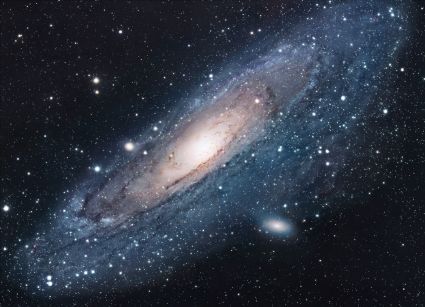 means that the universe would contract, and matter
is squeezed
together. Going further backwards in time,
eventually the matter density becomes infinite everywhere, so
the curvature of spacetime also becomes infinite. According to present
observations this happened 13.7 billon years ago, at a moment called Big Bang,
when spacetime, matter, and natural laws were created. To ask what happened
before Big Bang is nonsensical according to Einstein's theory, it is like asking
"what is north of the North Pole?".
means that the universe would contract, and matter
is squeezed
together. Going further backwards in time,
eventually the matter density becomes infinite everywhere, so
the curvature of spacetime also becomes infinite. According to present
observations this happened 13.7 billon years ago, at a moment called Big Bang,
when spacetime, matter, and natural laws were created. To ask what happened
before Big Bang is nonsensical according to Einstein's theory, it is like asking
"what is north of the North Pole?".
However, no one expects general relativity to be correct when gravity, and hence
spacetime curvature, becomes infinitely large. When approaching these scales
general relativity has to be generalized to also take into account quantum
mechanical effects (quantum mechanics is the physical theory that describes
microscopic phenomena such as atoms and elementary particles) to produce a new
theory of
quantum gravity, something no one has succeeded with so far. There are
several attempts, like loop quantum gravity and string theory, where the latter
also has the ambition to unify all forces and quantum mechanics into a single description of nature as we know it. The future will tell us if our quest for a better understanding of the world we live in will succeed or not, but for sure we will fail if no one makes the attempt.