String Theory (switch to Swedish)
(Marcus Berg, Jürgen Fuchs)
The established
Standard Model of
particle physics
is a quantum
theory, where all
matter is built out of quarks (like
in the proton) and leptons (like electrons),
point particles of exactly zero radius.
At first sight, this seems strange:
why couldn't the elementary building blocks
be extended objects of nonzero size?
In fact, many
physicists in the past attempted to create such theories
and failed,
like a prescient
paper from 1962
by Paul
Dirac, one of the founders of quantum theory.
In modern physics, string theory
is the only known
example
of a microscopic theory of extended objects
that seems to be free from internal problems.
A perhaps even deeper question about the world we live in is:
why are there three spatial dimensions:
height, length and width?
Unlike the question about nonzero size,
this seems like a stupid question at first sight: what else could there be?
But extra dimensions of space
is an old idea, one of the first to think about this
was a Swedish physicist,
who got Einstein interested in the idea. What is amazing in string theory
is that the possible existence of new spatial dimensions is connected to the hypothesis
of nonzero size of the elementary objects.
This follows from a mathematical calculation
that can be performed in a Master's level physics course.
In the 1990s, it was realized that the elementary objects of
string theory can look not only like strings
(imagine a tiny, tiny guitar string), but
there are also "membranes" (like drumskins,
or higher-dimensional analogs thereof).
These membranes are simply
the places where strings can end.
In a mechanics course,
we might study oscillations of a guitar string, and
the mathematical description
of this is a differential equation
with
a so-called "Dirichlet condition"
where the string is stuck.
So these elementary membranes are called Dirichlet-branes
or D-branes
for short.
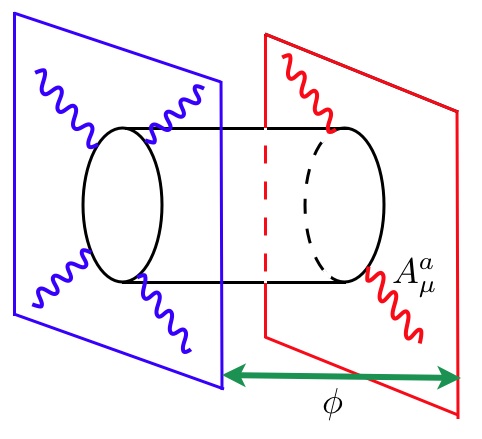
Now,
the D-brane can vibrate like a drumskin,
and calculating the vibrations of the D-brane
we find matter particles like
quarks and leptons
that we set out to describe, but also
other particles like the one labelled
 in the figure on the right. These are found in the last column of the
"periodic table" of particles,
the column
that produces forces,
and one example is the
gluon
particle, that provides the strong nuclear force that keeps the
proton together.
So D-branes capture all the known aspects of particle physics,
and more: the blue wiggly lines and the black tube in the figure
correspond to ripples in a gravitational field.
In fact, as you may have noticed, this picture expresses aspects of particle physics
as geometry,
which gives hope to connect
this theory to Einstein's successful
geometric
theory of gravitation (see "Research").
in the figure on the right. These are found in the last column of the
"periodic table" of particles,
the column
that produces forces,
and one example is the
gluon
particle, that provides the strong nuclear force that keeps the
proton together.
So D-branes capture all the known aspects of particle physics,
and more: the blue wiggly lines and the black tube in the figure
correspond to ripples in a gravitational field.
In fact, as you may have noticed, this picture expresses aspects of particle physics
as geometry,
which gives hope to connect
this theory to Einstein's successful
geometric
theory of gravitation (see "Research").
For D-branes of at least three spatial dimensions, our universe
can be located on the D-brane, like
the red one in the figure.
Particle processes are naturally confined to
this universe, but there can be another "universe"
(blue)
separated from us
in the extra dimensions
by a distance φ,
and the two D-branes interact
with gravity-like forces. The diagram
in the figure represents a specific
mathematical expression for a probability
that vibrations of the D-brane interact in a given way,
analogous to a
Feynman diagram in quantum theory.
At its simplest level, string theory is merely a set of rules
for calculating such probabilities.
Much of the effort to
find experimental tests of
string theory use D-branes.
In 2003, the first stable
string models were constructed that
contain the Standard Model and much beyond it,
see for example
this article.
Part of the focus on string theory research at KaU is:
what do these string models say about cosmology and particle physics?
And since this is all so new, what mathematical
tools
(like conformal field theory, see "Research")
do we need to develop to understand it better?
D-branes were also the tools which which the so-called
AdS/CFT correspondence was discovered in 1997, by
Juan Maldacena and others. This correspondence
is a powerful relation
between a strongly interacting (i.e. complicated)
particle theory on the one side,
to a weakly interacting (i.e. relatively simple) string theory with gravity,
but where the latter has one more dimension.
The hope is that this strong-weak "dictionary"
will provide new methods to calculate aspects of
the
strong nuclear force,
and it has also lead to new models in
the
physics of materials.
There is a useful
general article
about the correspondence by Maldacena
and one of his co-discoverers.
Finally, since you made it all the way down here, we can treat you to an informal
story of how string theory was indirectly useful for the
experimental search for a Higgs particle,
in this
blog
entry.